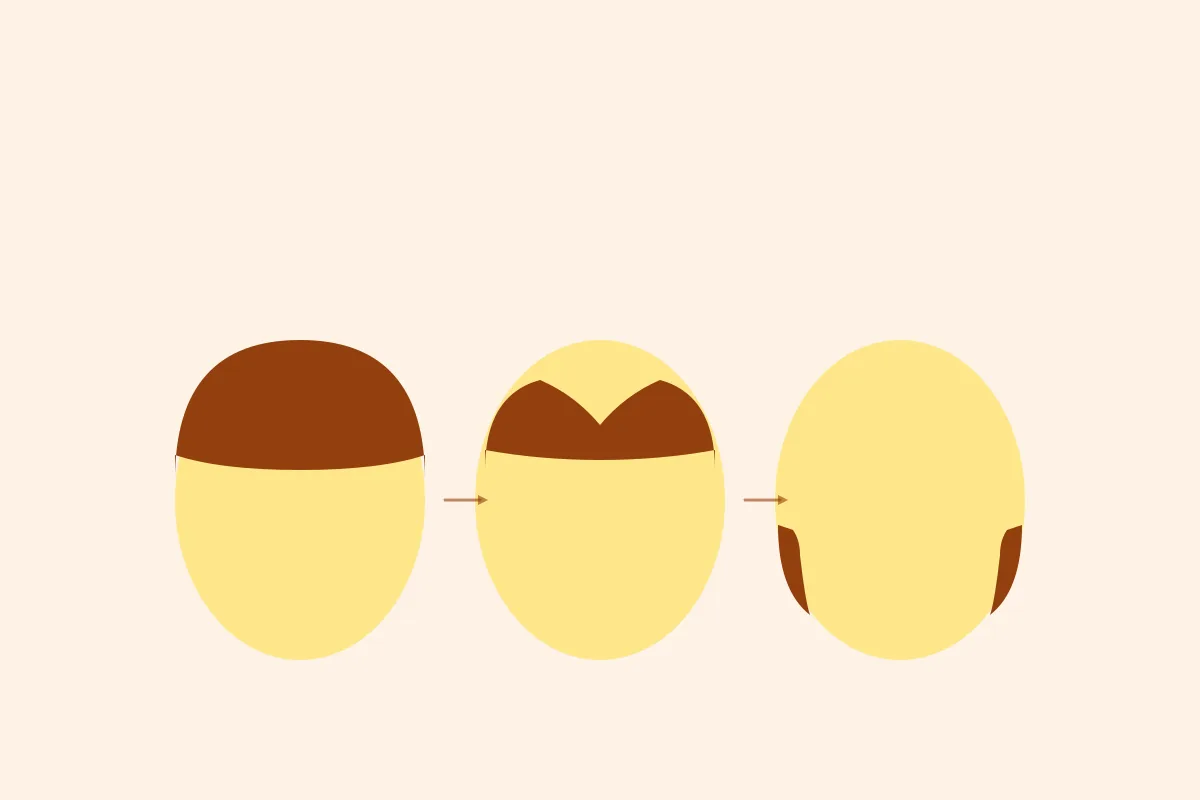
Before you can pick a treatment, you have to know what you're treating. The Norwood-Hamilton scale is the standard system dermatologists use to classify the pattern and severity of male androgenetic alopecia. It's also the framework that determines which treatments are still likely to work — and which ones are no longer realistic.
This guide walks through each stage with what it looks like, what it means biologically, and what the appropriate response is.
Stage 1: No visible loss
This is the baseline juvenile hairline most men have through their teens and early twenties. No recession, no thinning at the crown. If you're here and have a family history of hair loss, this is the ideal moment to take photos under consistent lighting and create a baseline. Most prevention strategies are far more effective than reversal.
Stage 2: Mature hairline
Slight recession at the temples — what's often called a 'mature hairline.' This is a normal adult male pattern and does not necessarily indicate AGA progression. Many men plateau here for life. If recession continues over 12–24 months, that signals true AGA and is worth addressing.
Stage 3: Early AGA
Distinct temporal recession that goes beyond a mature hairline — usually visible from the front. The crown may show early diffuse thinning. This is the stage where minoxidil and finasteride produce the most dramatic visual results, because the follicles are miniaturized but still mostly viable.
- Best window for finasteride to halt and partially reverse loss
- Topical minoxidil twice daily produces visible density improvements
- Microneedling adds meaningful effect when stacked with topicals
Stage 3 Vertex / Stage 4: Mid-stage AGA
Significant recession plus a thinning or bald spot at the crown. Most men consult a dermatologist at this stage, and it's still very treatable — but the response window is narrower than Stage 3. Combination therapy (finasteride + minoxidil + microneedling) becomes the recommended baseline rather than a maximalist option.
Stage 5–6: Advanced AGA
The frontal and crown regions have largely merged with only a thinning band of hair across the top. At this stage, medical treatment can stabilize remaining hair but full reversal isn't realistic. This is the stage where men commonly consider hair transplants, scalp micropigmentation, or shaving short and embracing the look.
Stage 7: Horseshoe pattern
Only the lateral and posterior bands of hair remain. Medical treatment has limited utility here — there's nothing left to preserve in the affected areas. The remaining hair is genetically resistant to DHT and is what's typically harvested for transplants. Many men at this stage do best by leaning into the look: a short clean cut, dense beard, well-maintained scalp.
What stage am I really in?
Most men underestimate their stage by half a step because they're seeing themselves in real-time under flattering bathroom lighting. Take photos from the front, top-down, and back under bright overhead light. Send them to a dermatologist or use one of the AI-based hair loss assessments. An accurate baseline beats a flattering one — especially when you'll compare it 6 months later.
Affiliate disclosure: Some links on this page are affiliate links. We may earn a commission if you purchase through them at no extra cost to you. Our editorial picks are independent. Read our policy.
Frequently asked questions
Frequently Asked Questions
The questions we get asked the most — answered straight.