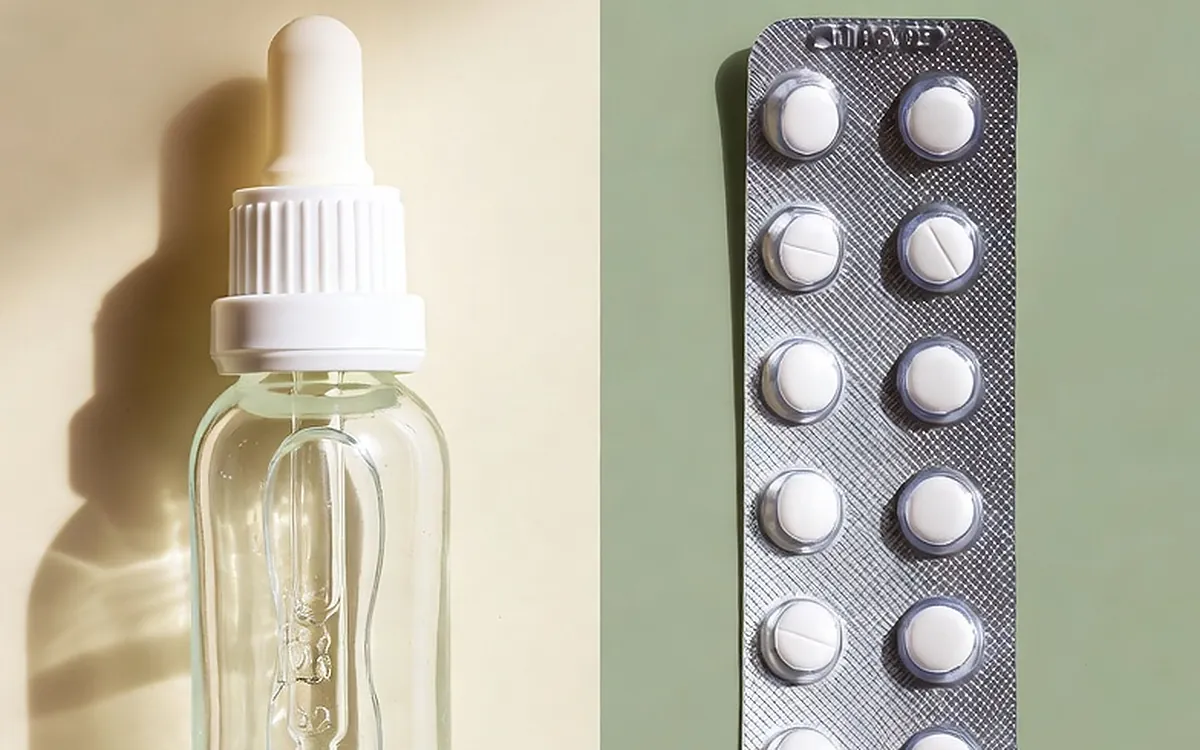
Minoxidil and finasteride are not really competitors — they attack hair loss from two different angles, and the strongest results come from using them together. Finasteride lowers the hormone that causes genetic balding; minoxidil prolongs the growth phase of the follicles you still have. If you can only pick one, finasteride does more to stop the underlying loss, while minoxidil is the easier, no-prescription place to start.
At a glance
| Minoxidil | Finasteride | |
|---|---|---|
| Mechanism | Extends the growth (anagen) phase | Lowers DHT (the cause of AGA) |
| Form | Topical or low-dose oral | Oral 1mg tablet |
| Access | OTC (topical) | Prescription |
| Best at | Crown / vertex regrowth | Halting progression, hairline |
| Main downside | Scalp irritation, initial shed | Possible sexual side effects |
| Works while used? | Yes — ongoing | Yes — ongoing |
How each one works
Finasteride is an oral 5-alpha-reductase inhibitor. It blocks the enzyme that converts testosterone into DHT — the hormone responsible for shrinking follicles in male pattern baldness. By cutting scalp DHT substantially, it addresses the cause of the loss.
Minoxidil is a topical (and increasingly, low-dose oral) vasodilator. It doesn't touch DHT at all. Instead it extends the anagen, or growth, phase of the hair cycle and improves blood flow to the follicle, helping existing hairs grow longer and thicker. It treats the symptom, not the cause.
What the evidence says
Both are FDA-approved and both have strong independent trial data — which is exactly why they're the two pillars of evidence-based hair loss treatment. Finasteride stops progression in the large majority of men and produces visible regrowth in a substantial share over 1–2 years. Minoxidil reliably improves hair count versus placebo over roughly a year, working best on the crown and less so at the hairline.
Side effects compared
Finasteride's notable concern is sexual side effects — reduced libido or erectile difficulty — reported by a small minority in trials, usually reversible on stopping. A rarer, disputed condition called post-finasteride syndrome describes persistent symptoms; it's not well understood and is part of why some men avoid the drug.
Minoxidil's side effects are mostly local: scalp irritation, dryness, flaking (often from the propylene glycol in the liquid — the foam avoids it), and an initial shedding phase. Oral minoxidil can add fluid retention, a faster heartbeat, and unwanted body hair, so it needs medical supervision.
So which should you use?
- Want maximum results and comfortable with a prescription: use both — the gold-standard combo
- Nervous about hormonal side effects or not ready for a prescription: start with topical minoxidil
- Hairline-focused loss: finasteride tends to do more — the hairline responds poorly to minoxidil alone
- Crown thinning: minoxidil performs well here and is a reasonable first move
Ready to start finasteride or minoxidil?
Online clinics prescribe both after a quick consult and ship to your door.
Getting started
Minoxidil is available over the counter, so it's the simplest entry point. Finasteride requires a prescription — which is where telehealth platforms have made things easy, prescribing finasteride, minoxidil, or both after an online consult.
Whichever route you take, the most important variable isn't which drug you choose — it's consistency. Both only work while you use them, and both take 3–6 months to show real change. The hair you keep is always easier to hold than the hair you've already lost.
Affiliate disclosure: Some links on this page are affiliate links. We may earn a commission if you purchase through them at no extra cost to you. Our editorial picks are independent. Read our policy.
Frequently asked questions
Frequently Asked Questions
The questions we get asked the most — answered straight.